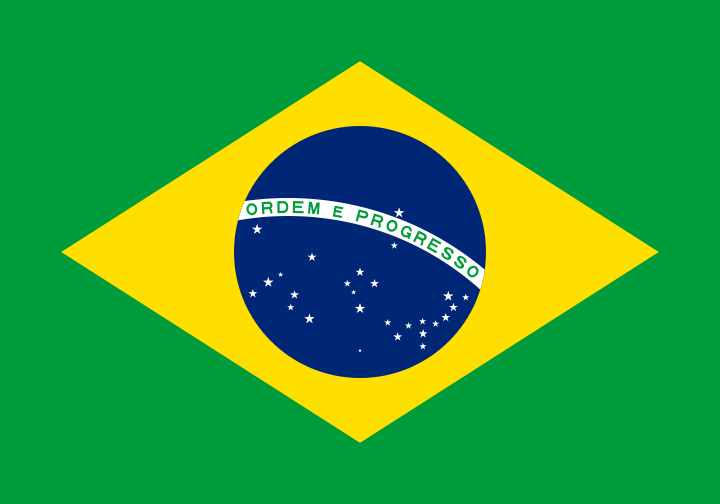
BRAZIL


HISTORY
The history of Brazil starts with indigenous people inBrazil. Europeans arrived in Brazil at the opening of the 16th century. The first European to colonize Brazil was Pedro Álvares Cabral on April 22, 1500 under the sponsorship of Portugal. From the 16th to the early 19th century, Brazil was a colony of Portugal.
TIMELINE
1981 Publication becomes an annual product and is renamed The World Factbook. A total of 165 nations are covered on 225 pages.
1983 Appendices (Conversion Factors, International Organizations) first introduced.
1984 Appendices expanded; now include: A. The United Nations, B. Selected United Nations Organizations, C. Selected International Organizations, D. Country Membership in Selected Organizations, E. Conversion Factors.
1987 A new Geography section replaces the former separate Land and Water sections. UN Organizations and Selected International Organizations appendices merged into a new International Organizations appendix. First multi-color-cover Factbook.
1988 More than 40 new geographic entities added to provide complete world coverage without overlap or omission. Among the new entities are Antarctica, oceans (Arctic, Atlantic, Indian, Pacific), and the World. The front-of-the-book explanatory introduction expanded and retitled to Notes, Definitions, and Abbreviations. Two new Appendices added: Weights and Measures (in place of Conversion Factors) and a Cross-Reference List of Geographic Names.Factbook size reaches 300 pages.
1989 Economy section completely revised and now includes an Overview briefly describing a country's economy. New entries added under People, Government, and Communications.
1990 The Government section revised and considerably expanded with new entries.
1991 A new International Organizations and Groups appendix added. Factbook size reaches 405 pages.
1992 Twenty new successor state entries replace those of the Soviet Union and Yugoslavia. New countries are respectively: Armenia, Azerbaijan, Belarus, Estonia, Georgia, Kazakhstan, Kyrgyzstan, Latvia, Lithuania, Moldova, Russia, Tajikistan, Turkmenistan, Ukraine, Uzbekistan; and Bosnia and Hercegovina, Croatia, Macedonia, Serbia and Montenegro, Slovenia. Number of nations in the Factbook rises to 188.
1993 Czechoslovakia's split necessitates new Czech Republic and Slovakia entries. New Eritrea entry added after it secedes from Ethiopia. Substantial enhancements made to Geography section.
1994 Two new appendices address Selected International Environmental Agreements. The gross domestic product (GDP) of most developing countries changed to a purchasing power parity (PPP) basis rather than an exchange rate basis. Factbook size up to 512 pages.
1995 The GDP of all countries now presented on a PPP basis. New appendix lists estimates of GDP on an exchange rate basis. Communications category split; Railroads, Highways, Inland waterways, Pipelines, Merchant marine, and Airports entries now make up a new Transportation category. The World Factbook is first produced on CD-ROM.
1996 Maps accompanying each entry now present more detail. Flags also introduced for nearly all entities. Various new entries appear under Geography and Communications. Factbook abbreviations consolidated into a new Appendix A. Two new appendices present a Cross-Reference List of Country Data Codes and a Cross-Reference List of Hydrogeographic Data Codes. Geographic coordinates added to Appendix H, Cross-Reference List of Geographic Names. Factbook size expands by 95 pages in one year to reach 652.
1997 The World Factbook introduced onto the Internet. A special printed edition prepared for the CIA's 50th anniversary. A schema or Guide to Country Profiles introduced. New color maps and flags now accompany each country profile. Category headings distinguished by shaded backgrounds. Number of categories expanded to nine with the addition of an Introduction (for only a few countries) and Transnational Issues (which includes Disputes-international and Illicit drugs).
1998 The Introduction category with two entries, Current issues and Historical perspective, expanded to more countries. Last year for the production of CD-ROM versions of the Factbook.
1999 Historical perspective and Current issues entries in the Introduction category combined into a new Background statement. Several new Economy entries introduced. A new physical map of the world added to the back-of-the-book reference maps.